Five-Minute Stress Relief Techniques at Your Desk

U4RIA
Mindful Writer
Five-minute stress relief techniques at your desk are defined as brief, science-backed practices that reset your nervous system without requiring you to leave your workstation. Techniques like cyclic sighing, progressive muscle relaxation, and sensory grounding each target the body's stress response directly and measurably. The CDC recommends integrating micro-steps of stress management ranging from 30 seconds to 3 minutes into the workday. That guidance exists because short, frequent resets build adherence far better than longer sessions you never actually schedule. U4RIA's own user data reinforces this: 92% of people who practice brief daily resets report reduced anxiety. None of these techniques require a yoga mat, a quiet room, or a closed door.
What are the most effective five-minute breathing techniques at your desk?
Breathing is the fastest lever you have over your nervous system. Unlike muscle relaxation or sensory exercises, breath control works within seconds because it directly influences the vagus nerve, which triggers your body's calm-down response.
Cyclic sighing is the most research-supported option for desk use. The pattern is a 4-second inhale through the nose, a short second inhale to fully expand the lungs, then a slow 8-second exhale through the mouth. Daily cyclic sighing over one month shows notable reductions in mood disruption and anxiety markers. Five minutes of this pattern is enough to shift your physiological state.
The 60-second breathing reset is the option for moments when stress spikes fast. A 4-second inhale paired with an 8-second exhale resets the nervous system within a single minute. It works because the extended exhale activates the parasympathetic branch of the autonomic nervous system, slowing heart rate and reducing cortisol output.
Box breathing adds a hold phase: inhale for 4 seconds, hold for 4, exhale for 4, hold for 4. It is widely used by military personnel and emergency responders for rapid focus recovery. Coherent breathing simplifies things further: breathe in for 5 seconds, breathe out for 5 seconds, and repeat for 5 minutes.
| Technique | Inhale | Hold | Exhale | Best for |
|---|---|---|---|---|
| Cyclic sighing | 4 sec + 1 sec | None | 8 sec | Daily mood reset |
| 60-second reset | 4 sec | None | 8 sec | Acute stress spike |
| Box breathing | 4 sec | 4 sec | 4 sec | Focus recovery |
| Coherent breathing | 5 sec | None | 5 sec | Sustained calm |
Pro Tip: Anchor your breathing reset to a work trigger. Do three cycles of box breathing before every meeting or after you send a difficult email. The habit forms faster when it attaches to something you already do.
How can quick physical and sensory resets relieve desk stress?
Physical tension accumulates in predictable places during desk work: the shoulders, jaw, and hands. Most professionals do not notice the buildup until it becomes pain or fatigue. Targeted releases in these areas produce immediate relief.
Relaxing the jaw and letting the tongue drop from the roof of the mouth triggers a parasympathetic response. This single adjustment takes under 10 seconds and signals the nervous system to downshift. Tension in the jaw is one of the most overlooked stress indicators in office workers.
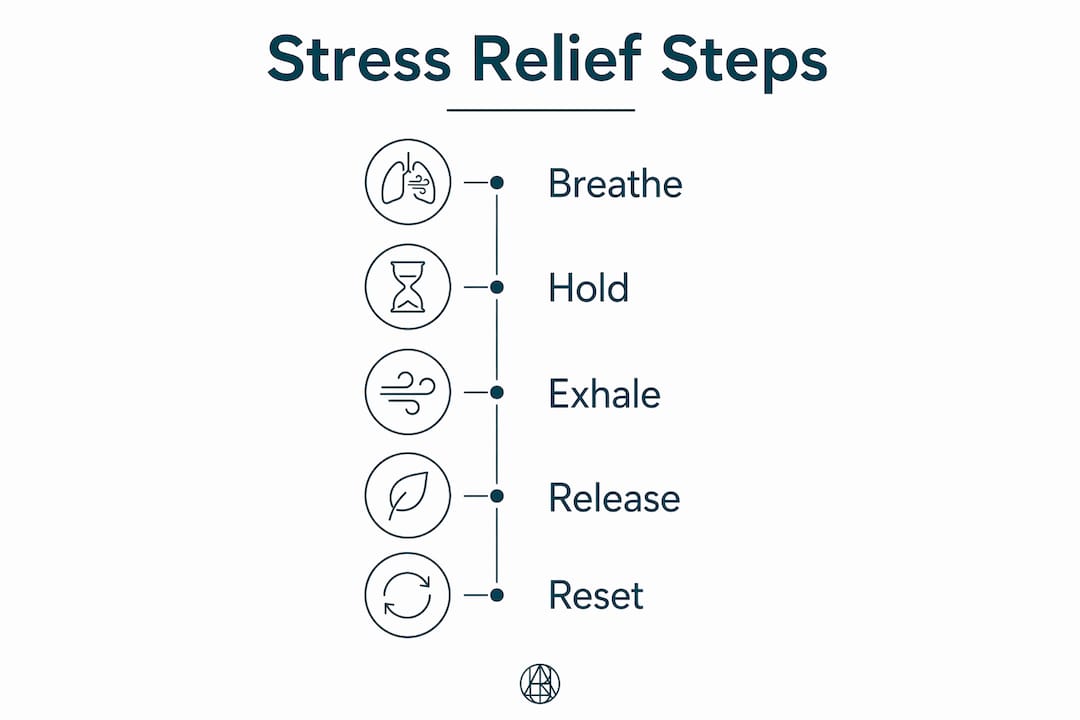
Physical movement during stress relief releases cortisol more effectively than stillness alone. Combining a shoulder roll with a breathing reset, for example, gives the body a physical outlet for the stress hormone rather than letting it sit in muscle tissue. Sensory grounding is the other major category of quick physical reset. It works by redirecting attention from anxious thought loops to present-moment sensory input — the clinical basis behind the 5-4-3-2-1 technique, widely used in cognitive behavioral therapy.
Here is a sequence you can complete in under five minutes at your desk:
- Jaw and tongue release (10 seconds): Let your jaw drop slightly. Let your tongue rest on the floor of your mouth. Breathe out slowly.
- Shoulder rolls (30 seconds): Roll both shoulders backward five times, then forward five times.
- Hand squeeze and release (30 seconds): Clench both fists tightly for 5 seconds, then release fully. Repeat three times.
- Sensory grounding: 5-4-3-2-1 (2 minutes): Name 5 things you see, 4 you can touch, 3 you hear, 2 you smell, 1 you taste.
- Posture reset (30 seconds): Sit tall, roll shoulders back, place feet flat on the floor, and take three slow breaths.
Pro Tip: Use sensory grounding specifically when your mind feels scattered or you cannot concentrate. It pulls attention back to the present faster than any thought-based technique.
What tools and habits support consistent desk stress relief practice?
Consistency matters more than technique quality. A breathing reset done daily for two weeks outperforms a perfect 20-minute session done once. The challenge is building the habit without relying on willpower.
Anchoring stress relief to digital work triggers is the most reliable method. Link a breathing reset to opening your email client each morning. Link a jaw release to closing your laptop at lunch. The trigger does the remembering for you, so the behavior becomes automatic within weeks.
Environmental setup also matters. A cluttered desk raises baseline cognitive load, which amplifies stress perception. Keeping your physical workspace clear reduces the mental friction that makes stress worse. A single plant, a glass of water, or a small object with a pleasant texture can serve as a sensory anchor during grounding exercises.
| Micro-break approach | Duration | Best environment | Primary benefit |
|---|---|---|---|
| Breathing reset only | 1–5 min | Any setting | Nervous system calm |
| Movement plus breathing | 3–5 min | Private or semi-private | Cortisol discharge |
| Sensory grounding | 2–3 min | Open office | Focus recovery |
| Posture and stretch | 1–2 min | Any setting | Muscle tension relief |
Timers and app-based reminders remove the decision fatigue of remembering when to reset. Setting a recurring reminder every 90 minutes aligns with the brain's natural ultradian rhythm — the roughly 90-minute cycle of focus and rest that neuroscientists have documented in cognitive performance research.
Pro Tip: In an open office, practice "invisible mindfulness." Keep your eyes open with a soft, unfocused gaze rather than closing them. You get the same nervous system benefit without signaling to colleagues that you have checked out.
How do you troubleshoot common challenges with five-minute desk resets?
The three most common obstacles are feeling too busy, feeling self-conscious, and struggling to focus during the exercise. Each has a direct fix.
"Too busy" is almost always a perception problem. Micro-breaks as short as 30 seconds improve adherence and produce measurable stress reduction. If five minutes feels impossible, start with one minute of box breathing. Build from there once the habit is established.
Self-consciousness in open offices disappears when you use invisible techniques. Soft-gaze mindfulness, jaw releases, and coherent breathing are all invisible to colleagues. Nobody watching you type can tell you are doing a breathing reset.
Difficulty focusing during the exercise is normal at first. The goal of brief desk mindfulness is not to empty the mind. It is to anchor attention and calm the nervous system. Noticing that your mind wandered and returning to the breath counts as the practice working, not failing.
- Match the technique to the stress type. Acute spike? Use the 60-second reset. Scattered focus? Use sensory grounding. Muscle tension? Use progressive relaxation.
- Expect gradual improvement. Consistent micro-breaks prevent chronic stress accumulation better than occasional long sessions.
- Track your mood before and after each reset for one week. The pattern will motivate you to continue.
Pro Tip: Keep a simple 1-to-10 stress rating in a notes app before and after each reset. Seeing the numbers drop reinforces the habit faster than any motivational advice.
Key takeaways
Five-minute desk stress relief works because it targets the nervous system directly, and consistency over time prevents chronic stress from accumulating.
| Point | Details |
|---|---|
| Breathing is the fastest reset | Cyclic sighing and the 60-second reset calm the nervous system within minutes. |
| Physical releases matter | Jaw drops, shoulder rolls, and hand squeezes discharge cortisol that stillness cannot. |
| Anchor habits to triggers | Linking resets to email or meetings removes reliance on willpower. |
| Invisible techniques work in open offices | Soft-gaze mindfulness and coherent breathing are undetectable to colleagues. |
| Consistency beats intensity | Daily one-minute resets outperform occasional longer sessions for stress prevention. |
What five years of watching professionals reset has taught me
Most professionals treat stress relief as something they will do when things calm down. Things do not calm down. The workday does not create a convenient pause for you to recover. You have to insert the pause yourself, and it has to be small enough that skipping it feels harder than doing it.
What I have observed consistently is that the professionals who manage stress well are not doing anything dramatic. They are not meditating for 30 minutes at lunch. They are taking three slow breaths before a difficult call. They are rolling their shoulders while a document loads. They are letting their jaw relax for 10 seconds after reading a frustrating email. These are not wellness rituals. They are micro-interruptions to the stress cycle, and they work precisely because they are small.
The biggest misconception I encounter is that mindfulness at work requires a quiet space and a clear mind. Neither is true. The 5-minute meditation practices that actually stick are the ones that fit inside the workday as it already exists, not as you wish it were. Start with one technique. Do it for five days. The evidence will convince you better than any article can.
— U4RIA
How U4RIA supports your daily desk stress practice
Knowing the techniques is one thing. Having them ready when stress spikes is another. U4RIA is built for exactly that gap.
U4RIA's guided breathing and meditation features include structured breathing exercises, guided meditations timed for five minutes or less, and an SOS Wheel that delivers instant support when anxiety spikes without warning. The app's AI-personalized audio messages adapt to your current stress state, so you are not choosing from a generic library when you are already overwhelmed. With over 150,000 downloads and a 4.9/5 App Store rating, U4RIA has proven its value in real workdays, not just ideal conditions. Teams looking for a structured approach can also review the workplace wellness pilot study showing measurable results from short daily resets.
FAQ
What are the best five-minute stress relief techniques at a desk?
Cyclic sighing, box breathing, and the 5-4-3-2-1 sensory grounding method are the most effective options for desk use. Each takes under five minutes and requires no equipment or private space.
How does the 60-second breathing reset work?
Inhale for 4 seconds, then exhale slowly for 8 seconds. The extended exhale activates the parasympathetic nervous system and reduces cortisol output within one minute.
Can I do desk stress relief in an open office without anyone noticing?
Yes. Soft-gaze mindfulness, coherent breathing, and jaw releases are all invisible to colleagues and equally effective as closed-eye techniques.
How often should I take stress relief breaks at my desk?
The CDC recommends micro-steps of stress management ranging from 30 seconds to 3 minutes throughout the workday. A reset every 90 minutes aligns with the brain's natural focus-rest cycle.
Does physical movement improve stress relief at the desk?
Physical movement during a reset discharges cortisol more effectively than stillness alone. Combining shoulder rolls or hand squeezes with a breathing exercise produces faster recovery than breathing by itself.
Comments (0)
No comments yet. Be the first to comment!