
Nature Sounds Benefits: What Science Says About Sound Therapy, Stress, and Focus

U4RIA
Mindful Writer
Have you ever pressed play on rain sounds, ocean waves, or a soft ambient track and felt your whole body exhale?
Maybe your jaw unclenched. Maybe your thoughts slowed down for the first time all day. Maybe, for a moment, you felt like yourself again.
That shift is not just in your head. Research suggests that certain sound environments can support stress recovery, improve mood, and help the brain feel less overloaded. In other words, the benefits of nature sounds are not just about “good vibes.” They are about how the nervous system responds to sound.
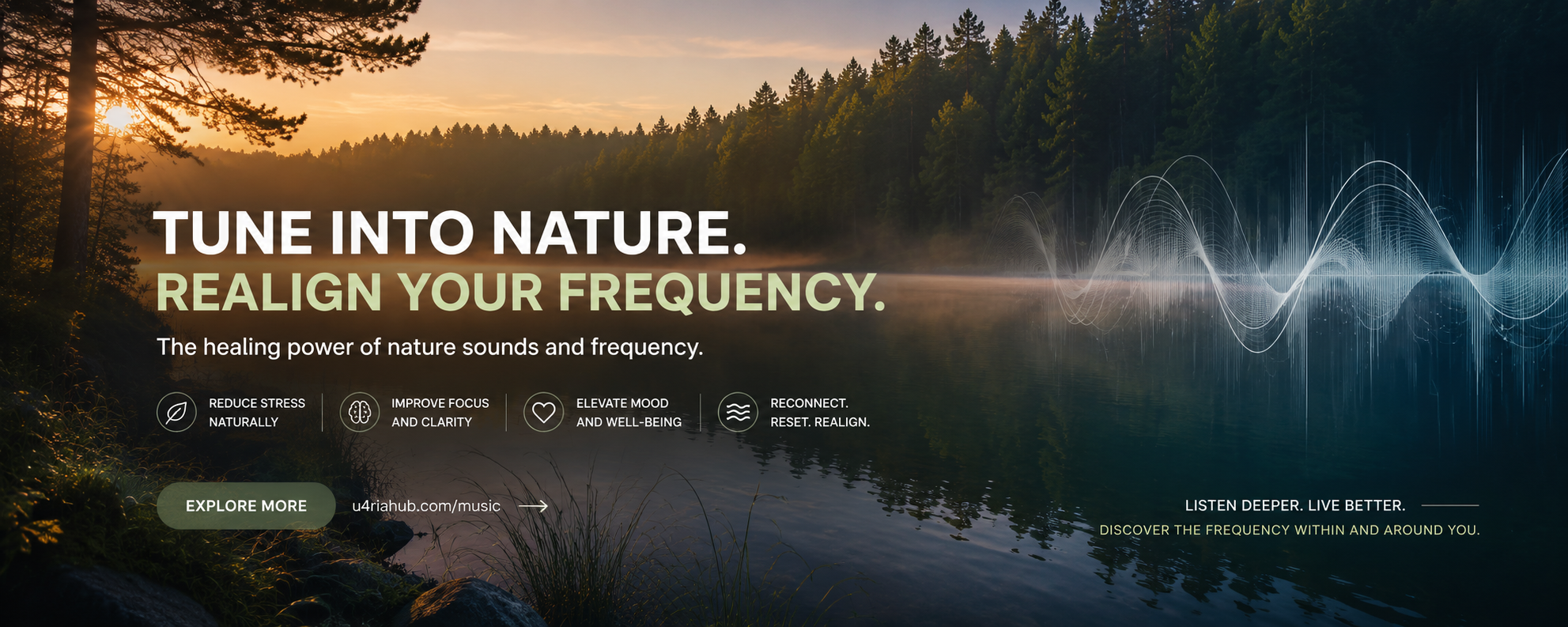
And in a world that feels loud all the time, that matters.
How often do you move from one task to the next without a real pause? How often do you say you are fine when your mind feels crowded and your body feels tired? What if something as simple as sound could help you come back to yourself?
That is part of the idea behind U4RIA Music, which offers calming audio experiences designed to help people reset, breathe, and find a little more peace in the middle of real life.
What Do People Mean by Frequency, Vibes, and Sound Healing?
Every sound is made of vibration. Frequency is simply the speed of that vibration, measured in hertz. So yes, music, ambient audio, and nature soundscapes are all built from frequencies.
But when people talk about a sound that “hits different,” they usually mean something more human than technical:
- Pitch
- Rhythm
- Texture
- The emotional and physical feeling the sound creates
Because that feeling is real, even if the language around it gets fuzzy.
Some sounds make you tense up without noticing. Others feel soft, spacious, and safe. Some feel like pressure. Others feel like relief. And if you have ever felt calmer the second birdsong, rainfall, or distant waves filled the room, you already know that your body can tell the difference before your mind explains it.
The Science Backed Benefits of Nature Sounds
Why do nature sounds feel so comforting?
One reason is that they can reduce sensory overload and help the brain interpret the environment as less threatening.
A 2021 systematic review and meta analysis published in PNAS found that natural sounds were associated with improved health outcomes, more positive mood, and lower stress and annoyance. Water sounds showed especially strong links to positive health outcomes, while bird sounds were particularly associated with stress relief.
That means the instinct to reach for rain sounds after a hard day is not random. It may actually reflect a real biological response.
When life feels noisy, inside or outside, what kind of sound do you reach for? Silence? Music? A storm track? A forest loop? There is a reason those choices can feel deeply personal. Sometimes they are less about preference and more about what your nervous system needs.
How Nature Sounds May Help the Body Recover From Stress
The body does not just “feel” stress emotionally. It carries stress physically.
In a controlled study, Alvarsson, Wiens, and Nilsson, 2010, found that after a stress task, participants exposed to nature sounds showed faster recovery in skin conductance measures than those exposed to environmental noise.
In simple terms, the body calmed down more easily when the soundscape felt natural.
That is powerful, because so many people are not looking for a dramatic transformation. They are looking for one real breath. One moment of relief. One small reset between meetings, before bed, or in the middle of a difficult day.
Sometimes healing does not begin with a huge breakthrough. Sometimes it begins with finally feeling your shoulders drop.
Why Sound Therapy Works Even Better With Slow Breathing
Have you noticed that calming audio often makes you breathe differently without trying?
That matters.
A systematic review on slow breathing found that slower breathing practices were associated with autonomic nervous system changes, including higher heart rate variability and lower anxiety related arousal. Another systematic review of breathing practices for stress and anxiety found broadly positive effects across many interventions.
So when someone listens to a calming soundscape and starts breathing more slowly, several things may be happening at once:
- The sound feels gentler than everyday noise
- The breath begins to slow
- Attention becomes less scattered
- The body gets a signal that it is safe to relax
That is why even a short listening session can feel emotional. Not because it is magical, but because it may be one of the few moments in the day when the body stops bracing. If you want another calming practice, you can also explore how to release stress with breathwork.
What About Binaural Beats?
Binaural beats are often discussed in the same space as sound therapy, meditation, and focus audio. They happen when slightly different tones are played into each ear, creating the perception of a third internal beat.
The research here is promising, but mixed.
A 2019 meta analysis found an overall moderate effect across studies on cognition, anxiety, and pain perception. But a later systematic review in PLOS One concluded that the evidence for consistent brainwave entrainment remains uneven.
So the honest answer is this: binaural beats may help some listeners feel more focused or relaxed, but they should not be treated as guaranteed or universally proven.
Are 432 Hz and Other Healing Frequencies Proven?
This is where people often want a simple answer.
Is there one perfect frequency that changes everything? Is there one sound that heals everyone?
Right now, science does not support that kind of certainty.
There are some intriguing small studies. A randomized dental study found lower anxiety in music listening groups versus control, with lower cortisol in the 432 Hz group. A pilot study in emergency nurses also reported reduced stress markers during listening sessions.
Those findings are interesting, but still limited. They do not prove that one exact tuning frequency has universal healing power.
The stronger evidence based takeaway is simpler: calming sound may help people feel better, and specific frequency claims still need much more rigorous study.
What Actually Makes a Soundscape Feel Healing?
Most people do not need the perfect frequency. They need something that helps them feel safe enough to soften.
The soundscapes most likely to help are often:
- Natural and not jarring
- Rhythmic without feeling repetitive in a harsh way
- Spacious rather than crowded
- Easy to pair with breathing, rest, or a quiet mental reset
This is why many people turn to U4RIA Music when they need a pause that feels gentle, emotional, and immediate. The goal is not to overwhelm the listener with theory. It is to offer an experience that helps them come back to center.
Because sometimes what you need is not more input. It is a softer place to land.
Final Takeaway: Do Nature Sounds Really Make a Difference?
Yes, they can.
Research supports the idea that nature sounds may help reduce stress, improve mood, and support recovery after overload. Slow breathing appears to strengthen that effect. Binaural beats may be helpful in some cases, but the evidence is still developing. Claims around 432 Hz and other healing frequencies are intriguing, but not settled science.
But beyond the studies, there is also a quieter truth here.
People are tired. People are overstimulated. People are craving peace, even if only for two minutes.
So if nature sounds make you feel calmer, clearer, or more grounded, that matters. If a certain sound helps you breathe more deeply or feel less alone inside your own mind, that matters too. For nighttime support, you may also like learning about the power of bedtime stories for better sleep.
What would change if you gave yourself permission to pause? What would it feel like to stop pushing through and just listen for a moment?
Explore U4RIA Music and find the soundscape that helps you reset, breathe, and come back to yourself.
Comments (0)
No comments yet. Be the first to comment!