Brain Aneurysm Recovery: A Second Chance at Life and What to Do With It

Alex Majdpour
CEO of Shahi Jewelry Caifornia
There are moments in life that split your story into before and after.
For me, that moment came when I was about 40. I suffered a brain aneurysm. One moment, I was living my life and carrying work, family, problems, and obligations. The next, I was fighting for my life.
I spent about six months in a coma. My family had to face the chance of losing me. The future they had imagined with me was suddenly unclear. If I survived, my recovery would be hard. I was told I might never walk again or return to what most people call a normal life.
Yet nearly 20 years later, I am here. I'm living. I'm working. I'm dreaming. I'm building. And perhaps most of all, I learned that a second chance at life means changing how you live it.
After brain aneurysm recovery and a long coma, Alex looks back on how the experience changed his stress management, gratitude, optimism, and purpose. The piece shows that stress cannot be removed, but people can learn to respond with more care through perspective, breathing, meditation, and healthier habits. In the end, this is a story about using a second chance at life to live with more meaning, resilience, and a positive mindset.

Before my brain aneurysm, I didn't understand what stress was costing me
Before everything happened, I was busy. I carried pressure all the time. Like many people, I thought that was just what being responsible looked like. You work. You worry. You solve one problem and move to the next. You tell yourself you'll slow down later. Looking back, I did not fully see how much stress had become part of my daily life.
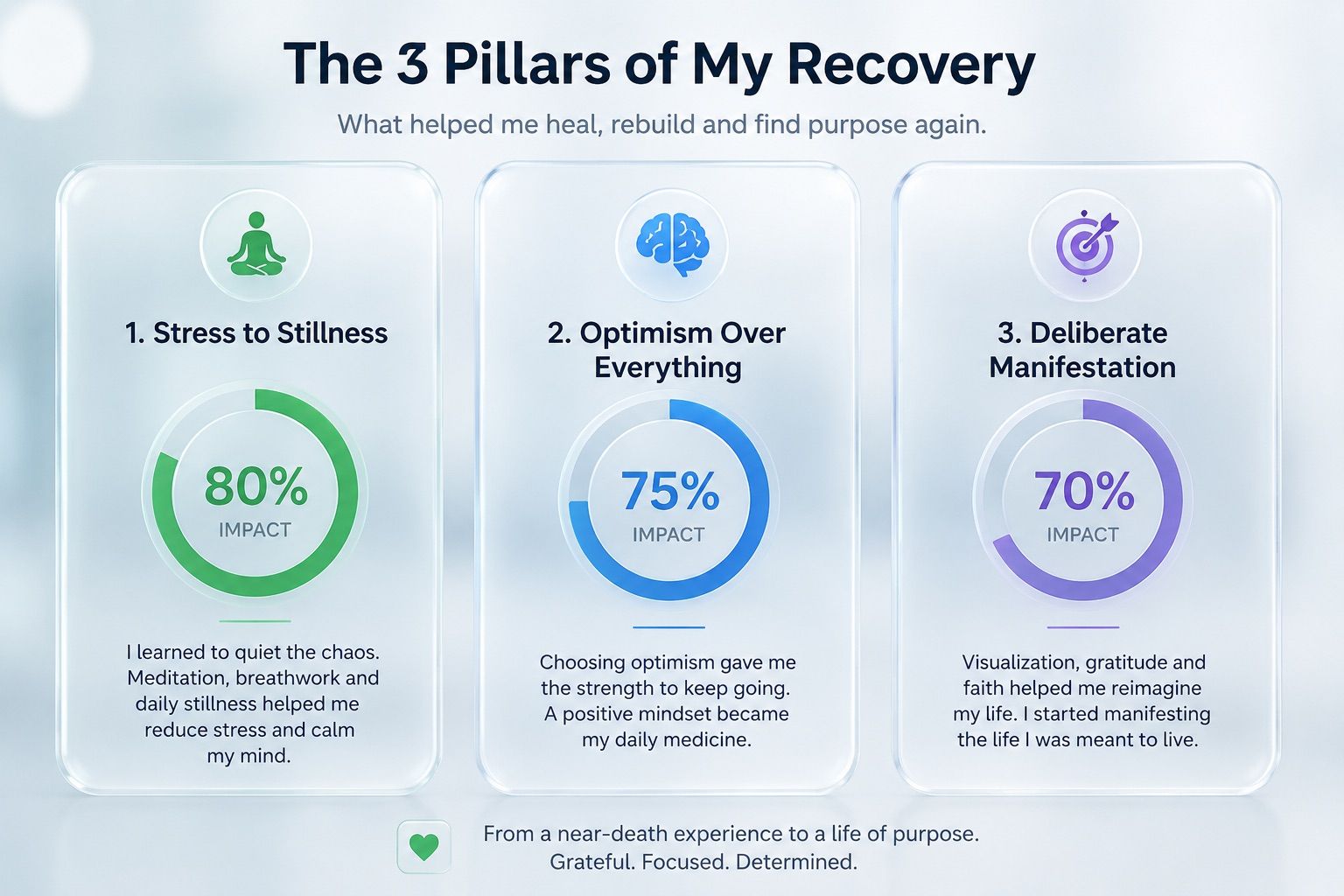
Today, I see stress very differently. I don't believe the lesson is that we can remove stress from our lives. That's not real. Businesses have problems. Families have problems. Bills come due. People let us down. Plans change. The lesson for me was learning not to let every problem become an emergency in my body and mind.
Research supports the value of stress management. Stanford Lifestyle Medicine describes stress as a bodily response that affects many systems in the body, and says that how we respond to stress matters. Stanford researchers also point to simple tools like focused breathing and meditation that can help lower the stress response. What happened to me made that idea deeply personal. I learned that life is too precious to spend all of it sweating the small stuff.
Waking up was only the beginning
Surviving was one thing. Recovery was another. When you are told that your future may look very different from the life you knew, you have to choose which voice gets the most power. There was the voice of fear. There were medical facts that had to be faced. There were limits. There was doubt. But there was also another voice inside me that kept saying: keep going.
Recovery became one day at a time. One movement. One step forward. One small win. Those wins may have looked small to someone else, but when you are rebuilding your life, small wins become huge. I refused to define my whole future by the worst prediction I had heard. That did not mean I ignored reality. It meant I would not stop believing there could be more.
The power of optimism became real to me
Optimism is often misunderstood. It is not pretending nothing bad is happening. It is not smiling while your world falls apart. And it is not thinking positive thoughts can magically erase a medical problem. For me, the power of optimism meant believing that tomorrow could still hold something worth fighting for.
Research from the Harvard T.H. Chan School of Public Health found a link between higher optimism and longer life. In one large study of more than 159,000 women, those with the highest optimism were more likely to live longer and reach age 90 and beyond. That does not mean optimism is medicine. It does suggest something I now believe deeply: how we face the future matters.
I could not control everything that happened to my body. But I could decide whether I believed my story was already over. I did not.
I started thinking differently about what I was creating
Over time, optimism became something more on purpose for me. I started thinking hard about what I wanted my life to look like instead of always focusing on what could go wrong. Some people call those imagery practices. Some call it manifestation meditation. Some call it intention. Some call it deliberate manifestation.
For me, manifestation is not sitting still and hoping the universe drops something at your door. It means getting clear about what you want, picturing it before it exists, and then moving toward it. Harvard Health has discussed studies on optimism and exercises that ask you to picture your best possible future self. That does not prove manifestation magically creates results. But it does support something important: imagining a good future can shape how we see what is possible. My experience taught me to stop spending all my mental energy replaying what could go wrong. Why not use some of that energy to picture what could go right?
From recovery to Shahi Jewelry
Jewelry had always been part of my family. Long before the aneurysm, the trade ran through generations a history in craft, in gold, in the kind of work that outlasts the person who made it. That legacy never left me, even during recovery. If anything, the years of rebuilding made it clearer: I wanted to create something that reflected both where I came from and who I had become.
Shahi Jewelry, based in Mission Viejo, California, grew from that foundation. As a designer, manufacturer, and retailer of fine gold, silver, and diamond jewelry, the business became the physical expression of everything I had been picturing during the hardest years of my life. Our motto "You Dream It, We'll Build It" says more about me personally than it might appear. I know what it means to hold a vision when the world around you is uncertain. I know what it takes to move toward something before anyone else can see it.
When I began building Shahi Jewelry, I did not just picture a vague idea of success. I pictured the space. I pictured how it would feel. I thought about the details the craftsmanship, the customers, the pieces that would one day mark someone's most meaningful moments. Even the smallest parts existed in my mind before I saw them in front of me. And then something remarkable happens when you start seeing parts of a vision become real: you understand, deeply, how much of building anything begins before anyone else can see it.
For me, Shahi Jewelry means more than business success. It is proof that there was a time when people were not sure what I would ever be able to do again and here I am, years later, creating something I had once only been able to picture.
Manifestation still requires movement
This is where I think talks about manifestation sometimes go wrong. You cannot use imagery instead of action. You cannot meditate instead of doing the work. You cannot repeat an affirmation and expect every problem to vanish. The mindset gives you direction. Then you have to move sometimes very slowly.
That is something recovery taught me better than almost anything else. You can picture yourself walking again. But then comes the work. You can imagine building a strong business. Then come the choices, risks, setbacks, and long days. You can imagine becoming less stressed. Then you have to learn what sets you off and practice a new response. The dream matters. The movement matters just as much.
Learning to pause before stress takes over
One of the biggest differences between the person I was before the aneurysm and the person I am today is my relationship with stress. I still feel it of course I do. But now I know I have tools. Sometimes that means stepping away. Sometimes it means changing my view. Sometimes it means asking if the thing I am worried about today will matter a year from now.
And sometimes it means something very simple: pause, breathe, reset. Stanford Medicine has pointed to research showing that focused breathing and meditation can help lower the body's stress response. That is one reason I have found tools like breathing exercises and meditation within U4RIA useful. They give me a chance to slow my mind and regain perspective when stress starts to get louder. You do not always need to disappear for a week. Sometimes you need a few clear minutes before you answer the next problem.
Gratitude looks different after you almost lose everything
Before my aneurysm, a bad day could feel huge. After almost losing my life, my view of a bad day changed. You start to notice things in a new way family, conversation, movement, work, food, laughter, another morning. Simple things stop feeling so simple.
My recovery taught me not to take life for granted. Every day began to feel more like a gift. That shift improved my gratitude and wellbeing. Gratitude does not mean ignoring hard things. It means hard things no longer get to erase everything that is still good. That changed me.
Don't wait until life forces you to stop
If there is one thing I would tell someone who is living under constant pressure, it is this: don't wait. Don't wait until your body or your life situation forces you to rethink how you are living. Don't wait until retirement to enjoy your life. Don't wait until you have made enough money. Don't wait until everything is perfect. Don't wait until the crisis.
- Take your mental wellbeing seriously now.
- Learn what helps you reset.
- Talk to someone when you need support.
- Move your body. Protect your sleep.
- Breathe. Meditate. Laugh more. Forgive faster.
- Ask yourself once in a while if the thing ruining your Tuesday really deserves that much of your life. Most of it does not.
The part of my story I never could have predicted
Maybe the biggest surprise in my story is what came next. At one point, I was the person trying to rebuild my own life. Today, I have the chance to inspire other people. Becoming a speaker who motivates others was not just about standing in front of people and telling them to think positive. It came from living through a moment when hope was not just an idea I needed it.
I know what it means to hear that your future may be limited. I know what it means to have your life change without permission. And I know what it means to wake up and decide: I'm still here. What am I going to do with that?
Maybe that is the real message behind my story. You do not control everything that happens to you I certainly did not. But you can shape what happens next. You can change your relationship with stress. You can focus more on what matters. You can imagine something better. You can work toward it. You can appreciate what is already here. And when life gives you another day, you can choose not to waste it worrying about things that were never worth losing yourself over in the first place.
I was given a second chance. My goal now is not just to have survived. It is to make that second chance count.
A moment for yourself
If this story made you think about the stress you are carrying, give yourself a moment to pause. U4RIA offers personal meditations, breathing exercises, affirmations, and everyday wellness experiences designed to help you create small moments of reflection, perspective, and intentional wellbeing throughout your day. Explore U4RIA and start making space for yourself today.
FAQ
What is the main lesson Alex learned from surviving a brain aneurysm?
Alex learned that a second chance at life should change how you live. His experience taught him not to let every problem become an emergency in his body and mind, and to meet life with more gratitude, intention, optimism, and perspective.
Does the article suggest that stress can be completely removed?
No. The article says stress is part of life because businesses, families, bills, plans, and relationships all bring problems. The key point is not to remove stress completely, but to change how we respond through tools like pausing, breathing, meditation, perspective, and healthier habits.
How does Alex define manifestation in this story?
Alex describes manifestation as getting clear about what you want, picturing it before it exists, and then taking action toward it. He says it is not passive wishing it needs movement, effort, choices, and persistence.
Why is Shahi Jewelry meaningful beyond business success?
For Alex, Shahi Jewelry proves that he could still create, build, and dream after a time when people were not sure what he would be able to do again. It stands for recovery, vision, and the power of believing in a future that once seemed unclear.
What practical steps does the article recommend for someone carrying constant pressure?
The article asks people to take mental wellbeing seriously before a crisis forces change. Suggested steps include learning what helps you reset, talking to someone when needed, moving your body, protecting sleep, breathing, meditating, laughing more, forgiving faster, and asking whether today's worry really deserves so much of your life.

Alex Majdpour
CEO of Shahi Jewelry Caifornia
Alex Majdpour, also known as Mr. Shahi, is a long-established entrepreneur with many years experience in the jewelry trade, shipping & logistics, real estate brokering, and financial services.
Comments (0)
No comments yet. Be the first to comment!